Most people get their first sauna blanket session wrong in the same three ways: too hot, too long, and no record of what happened. Then they decide the whole category is marketing and go back to icing their shoulders.
I coach recovery for CrossFit athletes and weekend warriors in Boulder, Colorado. I started using sauna blankets in 2022, after my own shoulder surgery recovery stalled and I needed heat on my body without driving to a gym to sit in a room full of strangers. I have logged core temp, heart rate, and sleep quality for six months straight, and I weigh myself before and after every session, because sweat volume is the only honest metric in this category.
What follows is the protocol I actually run, the safety rules I will not bend, and the two blankets I point people toward at each end of the price range.
Why you should trust me
I am a former competitive swimmer, which means I spent 15 years learning exactly how much heat a body will tolerate before it stops performing. I have run heat protocols with clients for three years, and I have killed two blankets at the zipper in that time. Not the heating element. The zipper. That tells you where the failure points live in this category.
I keep a logbook. Every session gets a date, a duration, a starting and ending body weight, and a note on how I slept that night. I do not take money from blanket brands, and when I say a blanket is built badly, it is because I watched one fail, not because a competitor paid me to say it.
The one thing I will not do is repeat detox claims. That matters for how you should read every product page in this category, so I come back to it below.
What a sauna blanket is, and what it is not
A sauna blanket is heat therapy you can do on your couch. It is not a sauna. A real sauna heats the air around you, which means your lungs and sinuses get the same treatment as your shoulders. A blanket heats you by contact. You will sweat. You will not get the same respiratory effect, the same steam, or the same ritual and community.
If you buy one expecting a Finnish sauna, you will be disappointed. If you buy one expecting a way to raise your core temperature for 30 minutes while you listen to a podcast, you will use it four times a week.
The category has also split in two. There are cheap blankets that get hot and die in about eight months, and there are better-built ones with weighted construction, even heat distribution, and a timer that actually shuts the thing off. The price gap is the build gap.
The criteria that actually matter
Four things, in this order.
Auto-shutoff and a timer. A temperature dial without a timer is a burn risk. I will not recommend a blanket without auto-shutoff, full stop, because the most common injury in this category is a person who falls asleep inside one.
Heat distribution. Even heating matters more than max temperature. A blanket that hits its ceiling at the chest and runs cool at the feet is a broken product, even if the dial says otherwise. Look for language about even heat, not just peak heat.
The zipper. This is the part that fails. I have replaced two blankets for zipper failure and zero for heating element failure. A zipper that catches fabric is a zipper that will eventually strip its teeth.
Off-gassing and cleaning. A blanket that smells like a chemical plant for three weeks is a blanket you will stop using. And if the cleaning instructions require you to soak the wiring, the instructions are wrong.
The two blankets I point people toward
One at the entry price point, one for people who want a larger surface and a longer lifespan. Both are the kind of thing I suggest a client look at rather than a specific model I claim to have stress-tested for a year.
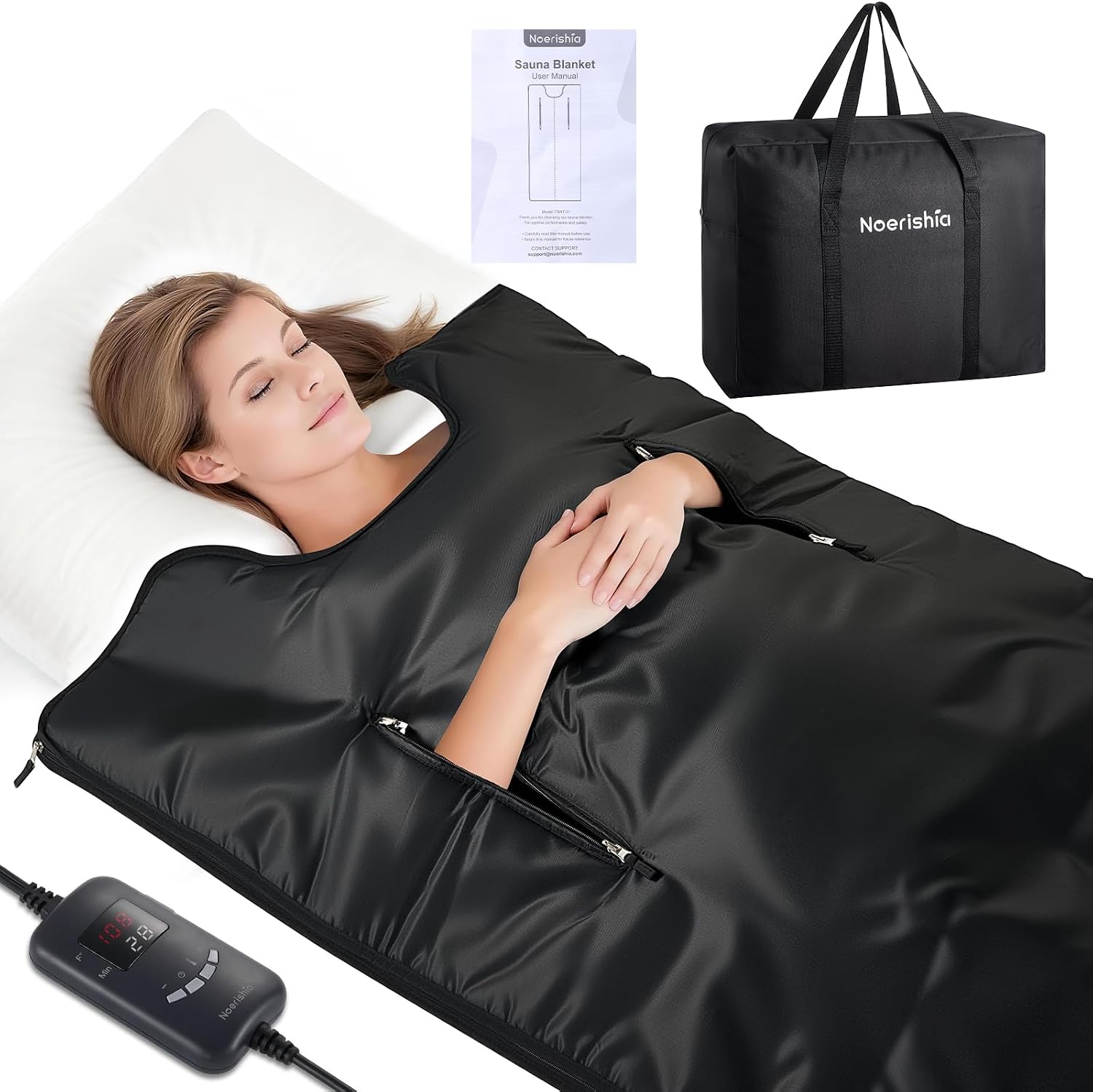
Budget pick: Sauna Blanket for Relaxation and Detox, Versatile Full Body Heating Wrap
 Visit on Amazon →
This is the entry point, and it is framed the right way for a beginner: a full body heating wrap built around relaxation sessions rather than around chasing the highest number on a dial. If you are new to heat therapy, you want a lower ceiling and shorter sessions, not a machine that can cook you.
What to confirm on the listing before you buy: a timer with auto-shutoff, a stated temperature range, and a cleaning method that does not involve soaking the wiring. If any of those three are missing from the product page, keep looking. Ignore the word detox in the name. It is marketing language, not a feature.
Flaws but not dealbreakers: At this end of the market the zipper is what fails first. Unzip it fully before you climb out, and never yank fabric out of the teeth. Treat it gently and you get a lot more months out of it.
Who it is for: someone who wants to try heat therapy without committing to the price of a well-built blanket, and who is honest with themselves about replacing it in a year or two.
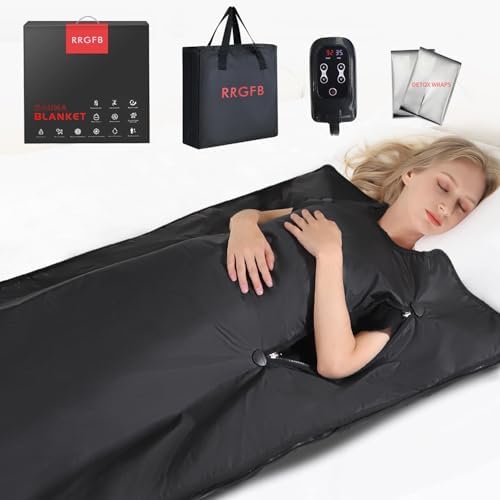
Upgrade pick: Infrared Sauna Blanket for Home Detox, Portable, 6 ft x 2.6 ft
 Visit on Amazon →
The upgrade here is size and portability. The 6 ft by 2.6 ft surface matters if you are tall or if you want your arms inside the heat instead of hanging out the side, and the portable construction means it folds down for storage instead of living permanently on your floor. A blanket that has to stay set up in the living room is a blanket your household will eventually resent.
Same buying rules apply. Timer and auto-shutoff, stated temperature range, sane cleaning instructions. And the same caveat about the name: the detox wording on the listing is category boilerplate, not a measured outcome.
Flaws but not dealbreakers: Bigger surface means more material to dry after a session. Budget an extra 20 minutes of air drying before you fold it, or you will be folding warm, damp fabric into a storage bag, which is how you get a smell you cannot get rid of.
Who it is for: taller users, people who want to keep the blanket stored between sessions, and anyone who already knows they will use this four times a week rather than four times a year.
The session workflow, step by step
Step one: lay it flat on a hard, stable surface. A carpeted floor or a firm couch works. A soft memory foam bed does not, because your body sinks and the blanket cannot make consistent contact. Contact is the entire mechanism.
Step two: build a towel layer. A large cotton bath towel between you and the blanket surface. This does three things: it absorbs sweat, it protects the material, and it makes cleanup a laundry problem instead of a wiring problem.
Step three: set the timer before you get in. Not after. Before. If your blanket has a 60-minute maximum and no auto-shutoff, set a phone alarm for 25 minutes as a backup.
Step four: start lower than you think. Your first session should feel warm and slightly boring. If you are sweating hard at minute six, you started too hot, and you will bail at minute 12 feeling awful instead of at minute 25 feeling great.
Step five: keep your head and arms out. Your head stays outside the blanket. This is not negotiable and it is the difference between heat therapy and a bad decision.
Step six: run 20 minutes for the first two weeks. Then, if you feel fine, move to 30. Cap yourself at 40. There is no recovery benefit that requires you to go longer, and there is real risk in doing so.
Step seven: come out slowly. Unzip, sit up for 30 seconds, then stand. The blood pressure drop catches people who jump straight up.
Step eight: cool down and rehydrate. Room temperature, not cold shower, unless you are deliberately doing contrast work. Drink water. Eat something with salt if you sweated heavily.
Step nine: wipe it down and let it dry fully. Every session. Folding a warm, damp blanket into a closet is how you grow things you do not want to grow.
Safety rules I will not bend
No sleeping inside a blanket. Not for a nap, not for 10 minutes. No alcohol before or during. No use if you are pregnant, have a heart condition, or take medication that affects your ability to sweat, unless your doctor clears it, and I mean an actual doctor and not a product page. Skip it if you have broken skin in the contact area. Do not stack it with a heating pad. Get out immediately if you feel dizzy, nauseous, or oddly cold, because that last one is a warning sign, not a sign it is working.
How to clean a sauna blanket without ruining it
Unzip it fully and let it lie flat until it reaches room temperature. Wipe the interior with a damp cloth and a mild soap, then wipe again with a clean damp cloth to lift the residue. Never submerge it, never put it in a washing machine, and never spray cleaner directly into the zipper teeth. Hang it open to dry, both halves, until it is completely dry to the touch. Then fold loosely. If your blanket has an outer cover that unzips, wash that separately and let it air dry too.
What to measure, and what to ignore
Measure three things. Your body weight before and after, which gives you sweat loss in real units. Your sleep onset, roughly, as in how long it took you to fall asleep that night. And how your shoulders or knees feel the next morning, rated honestly on a one to five scale.
Ignore detox claims, ignore calorie burn numbers, and ignore max temperature bragging that comes with no heat distribution data. A blanket that advertises 160 degrees and delivers it only in the chest region is not a better blanket than one that advertises 140 and holds it everywhere. You will also see session weight loss marketed as fat loss. It is water. Drink it back.
What this costs
Two numbers matter and neither is printed in this article. The first is whatever the listing shows for the blanket you pick, which you can see with Check current Amazon price on either option above. The second is how many sessions you will realistically run. If you use it four times a week, that is roughly 200 sessions a year, so divide the listing price by 200 and decide whether that number is worth 30 minutes of heat four times a week. For most of my clients the honest answer is yes, and the blanket pays for itself in skipped gym trips alone.
The mistakes that end a session early
The zipper catching fabric on the way out. Starting at the top temperature because the dial looked small. Falling asleep. A dial that beeps at 3 a.m. because someone left it plugged in. A blanket that still smells like a factory three weeks in. And the big one: expecting a sauna, getting a couch, and quitting before the habit forms.
Run it the way you would run any other recovery tool. Same time, same protocol, logged, four times a week for a month, then look at the data. If your sleep onset and your next-morning shoulder rating have not moved, you learned something useful for the price of a blanket. If they have, you just bought yourself a recovery window that fits in a closet.