Sauna blanket marketing reads like a spa brochure. Sweat out toxins. Burn hundreds of calories. Sleep like a rock. I have been logging sessions in one of these things since 2022, and the honest version is smaller and more useful than that.
Learning how to use a sauna blanket properly comes down to three variables: how hot, how long, and whether you can reliably get out before you fall asleep inside it.
I am Tessa, a recovery coach in Boulder, Colorado. Most of my clients are CrossFit athletes and weekend warriors who want heat therapy without driving to a spa and sitting in a room with strangers. What follows is the protocol I hand them, plus the two blankets I would start with if you are buying today.
Why you should trust me
I swam competitively into my thirties, and my shoulders paid for it. In 2022, my recovery from shoulder surgery stalled out, and a physical therapist suggested heat therapy as a way to get blood moving into tissue that had gone stiff. A dry sauna was a 25 minute drive each way. A blanket was a Tuesday night on my couch.
Three years later I have logged several hundred sessions. I weigh myself before and after each one and record the sweat loss in grams, because sweat volume is the only honest metric in this category. Everything else, the mood, the glow, the "I slept great" feeling, is a story you tell yourself. Grams are data.
I have also killed two blankets. Both died at the zipper, not the heating element. One of them ran hot along a shoulder seam and left me with a small scar on my upper back. That scar is why I will not recommend a blanket without an auto-shutoff timer, and why I keep telling people that the cheap end of this market is a lottery ticket.
Two ground rules before we go further. I am not a doctor, and nothing here is medical advice. If you are pregnant, or you have a heart condition, a pacemaker, uncontrolled blood pressure, or neuropathy that keeps you from feeling heat accurately, talk to your physician first and take their answer over mine. And I do not do detox claims. Your liver and kidneys handle that. What a sauna blanket can plausibly do is raise your core temperature, make you sweat, and give your nervous system a wind-down cue before bed.
This page has affiliate links. If you buy through them I earn a commission. It does not change what I recommend.
How I picked and how I tested
Every blanket I evaluate gets the same treatment. I run a 20 minute session at a moderate dial setting, log sweat loss in grams, note where the heat concentrates, and track sleep onset that night. I check the zipper under load, because a zipper that catches fabric will fail long before the heating wire does. I check for a timer and auto-shutoff. And I check whether the controller beeps at full volume, because a controller that shrieks at 3 a.m. when the session ends is a feature nobody asked for.
The two blankets below are the two I would tell a client to look at right now, for different reasons. One is a branded home unit built for a fixed spot in your living room. The other is a portable setup with a washable insert, which matters more than people expect once you realize you will be sweating into this thing four nights a week.
Here is what I look for in the category, in order: an auto-shutoff timer, even heat distribution from shoulders to feet, a zipper that does not catch, and a surface you can actually clean without a PhD in fabric care. Max temperature claims are the least useful number on the box. A blanket that hits hard in the chest and runs cold at the feet is a broken product no matter what the dial says.
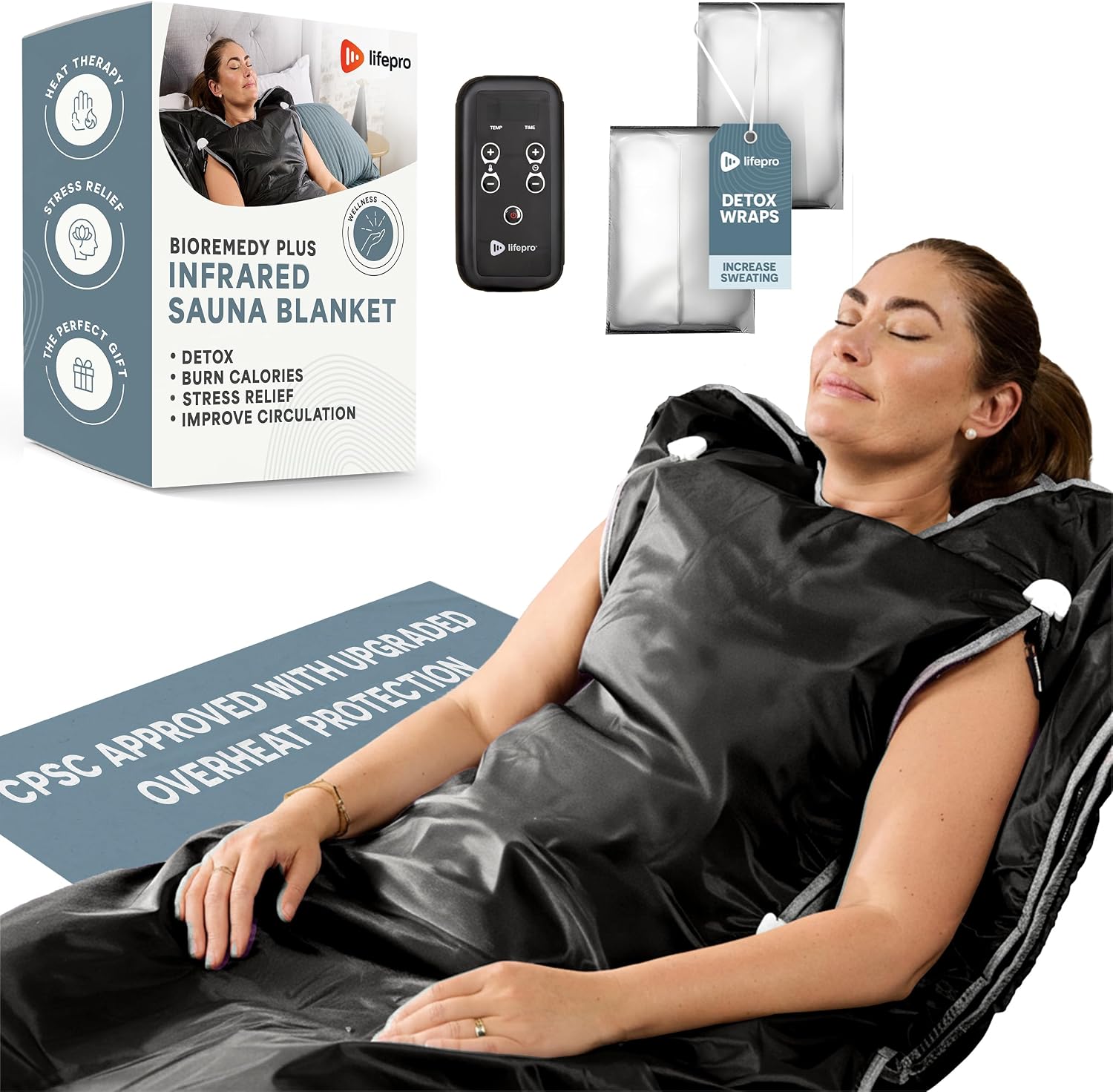
Our pick: LifePro BioRemedy Infrared Sauna Blanket for Home Relaxation Detox
 Visit on Amazon →
LifePro is one of the names that has been in the home recovery space long enough to have a track record, and this is the blanket I would point a client toward if the unit is going to live in one spot and get used several times a week. It is marketed for home relaxation, which is exactly the use case where a sauna blanket works and a sauna comparison falls apart.
The word "Detox" is in the product name. Ignore it. It is the marketing word, not the mechanism. What you are buying is a heated enclosure you lie inside for 20 to 40 minutes, and the value comes from the heat and the ritual, not from anything leaving your body that your kidneys were not already handling.
Before you buy, confirm two things on the listing that I consider non-negotiable: an auto-shutoff timer, and a stated operating range you can set low enough to start. If a listing cannot answer both of those questions in plain language, that is your answer.
Flaws but not dealbreakers: This is a home unit, not a travel unit. It is built to stay put. If you want something you can fold into a carry bag and take to a hotel, look at the next entry instead.
Anyone who wants a fixed station in a bedroom or spare room, and who will use it on a schedule rather than occasionally, should start here.
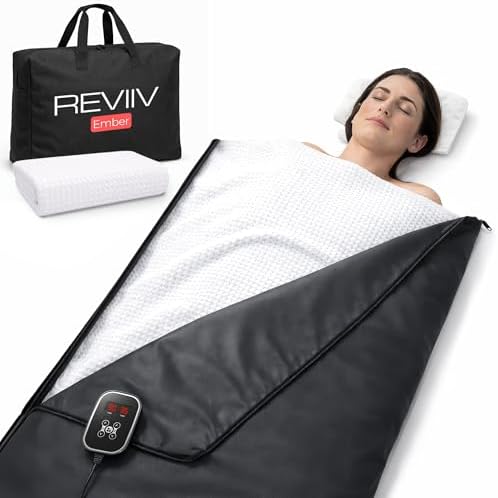
Best for travel and small spaces: Portable Infrared Sauna Blanket for Home, Carbon Fiber Far Infrared Heating, Low EMF Full Body Sauna Blanket with Washable Towel Insert, Carry Bag & Digital Controller, Relaxation & Recovery
 Visit on Amazon →
This one solves the two problems I hear about most. The washable towel insert addresses the sweat problem directly, and the carry bag addresses the "where does this thing live" problem. Carbon fiber far infrared heating and a listed low EMF rating are the specs to look at, and a digital controller means you can set a number instead of guessing at a click stop.
A washable insert is not a luxury. Without one, you are either wiping down a coated surface after every session or you are lying in last night's dried sweat. Four sessions a week for a year is over 200 exposures. Get the insert, wash the insert.
The same two questions apply. Confirm the auto-shutoff timer and confirm the low end of the temperature range, because a blanket whose lowest setting is already aggressive is a blanket that will burn you on week one. Portable also means thinner in most cases than a dedicated home unit, so if you want the heaviest construction available, that is a tradeoff you are making on purpose.
Flaws but not dealbreakers: Portable construction usually means the blanket drapes rather than weighted-fabric settles. For most people that is fine. If you thrash, expect to reposition it once or twice mid-session.
Anyone in an apartment, anyone who travels, and anyone who wants the insert-and-wash routine built in should look here first.
Before your first session: the setup
Do not start with a 45 minute session at the top of the dial. That is how people end up dizzy, dehydrated, and scared off the category forever.
Clear the surface. Lie the blanket flat on a couch, a bed, or a firm mat. Not a soft mattress that swallows you, and not a surface with anything sharp under it. The heating elements do not like being folded against themselves while hot.
Lay down a towel over the insert. Even with a washable insert, a bath towel on top extends the life of everything below it and gives you something to throw straight into the wash.
Hydrate before, not during. Drink 16 to 20 ounces of water in the hour before your session. Drinking inside the blanket means a wet zipper and a bathroom break at minute 12.
Set the timer before you get in. This is the single most important step in the article. Set 15 minutes for your first week. Set the temperature at the low end of the listed range. Get in.
Have a way out. Leave the zipper partially open at your chest for the first few sessions. You want to be able to breathe cool air and to exit without wrestling a zipper while overheated.
Put your phone outside the blanket. Heat and lithium batteries do not mix, and you will not be reaching for it anyway.
The actual session protocol
Step one: warm up gradually. Get in at the low setting, zip most of the way, and let your body come up to temperature over the first five minutes. Chills in the first two minutes are normal, as your skin temperature climbs past your core temperature.
Step two: stay 15 minutes for week one. Three sessions that week. Log how you feel and, if you want the honest metric, weigh yourself before and after and note the sweat loss in grams.
Step three: add 5 minutes at a time. Week two, go to 20 minutes. If sleep onset improves and you are not waking up at 2 a.m. dehydrated, push to 25 or 30. Most people top out between 30 and 40 minutes and never need to go further.
Step four: raise temperature slowly. Once 30 minutes feels routine, nudge the dial up a step. Never raise time and temperature in the same week. One variable at a time, or you will not know what helped and what made you feel awful.
Step five: watch for the two warning signs. Dizziness or a headache means stop, cool down, and drink water. Falling asleep inside the blanket means your sessions are too long and your setup is not safe. If you regularly doze off in there, cut the timer back until you do not.
Step six: get out on the timer, not on feel. The auto-shutoff is a backstop, not a schedule. End the session when the timer says so and unzip.
Cleanup, and why the zipper matters
Wipe down the interior surface with a damp cloth and a mild soap after every session, then let it hang or lie open until it is fully dry before you fold it. Fold it the same way every time, loosely, along the same lines. Never roll it tight and stuff it in a bag while warm.
Now the zipper. Two of my blankets died there, and both failed in the same place: the slider caught the inner fabric, bent, and never sealed evenly again. Zip slowly. Keep the fabric clear of the teeth with one hand while the other pulls. If your blanket came with a washable insert, wash it weekly rather than waiting for it to look bad, and check the zipper teeth for trapped fabric every time you finish.
Store it flat or loosely folded in a dry spot. A damp blanket folded into a bag is a smell you will not get out.
Who should skip this entirely
Pregnant people, anyone with a heart condition, anyone with a pacemaker or an implanted device, anyone with uncontrolled blood pressure, and anyone with neuropathy or a condition that dulls their sense of heat should talk to a doctor before using a sauna blanket and follow that advice over anything here.
Also skip it if you have been drinking. Alcohol plus heat plus a closed zipper is a bad combination, and every burn story I have heard starts somewhere near that sentence.
And skip it if you want a sauna. This is not a sauna. It is heat therapy on a couch, and if you buy it wanting the cedar room, the cold plunge, and the conversation, you will be disappointed. If you buy it for what it is, it is genuinely useful.
What this all costs
Check current Amazon price on both blankets before you commit, because this category moves. What I can tell you is how to think about the spend. The blanket itself is the smallest cost. The insert and towels are consumables. The electricity for a 30 minute session is pennies. The thing that actually costs you money is buying cheap twice.
That is the whole argument for spending on the front end in this category. A blanket with a real timer, even heat, and a zipper that survives a year of four-times-a-week use costs you a few cents a day over that year. A blanket that dies at month eight costs you the full price again, plus whatever you spend on the replacement, plus the burn risk you took on the whole time.
If you want the fixed-station home unit, that is the LifePro BioRemedy. If you want the portable one with the washable insert and the carry bag, that is the carbon fiber blanket above. Either way, set the timer low, add minutes slowly, and weigh yourself before and after your first session. The grams will tell you more than the marketing ever will.